Back from the evolution meeting. Five Pollock lab talks (titles below), all got good reviews. The python genome (and evolution and transcriptomics) work got picked up by PBS, Scientific American, and New Scientist. Exciting! This is a nice follow-on from the mitochondrial adaptive redesign and convergence work (PNAS, PLoS One, BMC Evolutionary Biology, CGR) and the just-published genome sampling work in GBE (also this in Mol. Ecol. Res), as well as a complement to the upcoming garter snake genome. (also picked up at Anguished Repose, Todd's Blog, HeartCareGuide, Reptile Deli, Road Runner, MSG.com, RC Reptiles.com)
POLLOCK, D.D.* - DE KONING, AP JASON - CASTOE, TODD - YOKOYAMA, KEN: Novel Bayesian solutions for investigating molecular coevolution and adaptation.
DE KONING, A. P. JASON* - CASTOE, TODD - POLLOCK, D. D.: Towards realism without over-parameterization: new approaches for modeling siteheterogeneous
evolution in protein-coding genes.
CASTOE, TODD* - DE KONING, AP JASON - HALL, KATHRYN - YOKOYAMA, KEN - FESCHOTTE, CEDRIC - SECOR, STEPHEN - POLLOCK, D. D.: The python genome and evolutionary genomics of snakes
YOKOYAMA, KEN* - POLLOCK, D. D.: Convergent co-evolution of transcription factor SP1 and its binding sites
STREICHER, J. W.* - CASTOE, TODD - INGRASCI, M. J. - POOLE, A. W. - SMITH, E. N. - POLLOCK, D. D.: Leveraging next-generation sequencing to disentangle species complexes in venomous coralsnakes
(Micrurus)
course is being taught Spring 2011. is now available (Friday, May 13).
Rapid likelihood analysis on large phylogenies using partial sampling of substitution histories by A. P. Jason de Koning, Wanjun Gu and David D. Pollock, Molecular Biology and Evolution (available online September 2009). Complex models, way fast. Check it out.
Evidence for an ancient adaptive episode of convergent molecular evolution,
Todd A. Castoe,
A. P. Jason de Koning,
Hyun-Min Kim,
Wanjun Gua,
Brice P. Noonan,
Gavin Naylor,
Zhi J. Jiang,
Christopher L. Parkinson and
David D. Pollock, PNAS, 2009
See PNAS commentary by Scott Edwards, "Natural Selection and Phylogenetic Analysis" (May/June 2009) .
See addendum/commentary by Castoe, de Koning, and Pollock (reprint available upon request)
We're looking for for NLM computational biology fellowships working on (Pollock) (Pollock) or transcription factor binging site () (Pollock and Kechris). Please contact David Pollock for details. To be eligible for fellowships, must be US citizen or permanent resident. We're generally interested in non-US citizens as well, but would have to find other sources of funding.
Having some fun discussing (baiting?) about vertebrate genomes (see finch genome link below) and bacterial genomes and the attention they should or shouldn't receive with my old friend Jonathan Eisen over on Carl Zimmer's blog.
The Finch Genome paper is out!
Two papers published in one day. First, "Adaptive evolution and functional redesign of core metabolic proteins in snakes" by Castoe, Jiang, Gu, Wang, and Pollock has been published at PLoS ONE.
Original news postings : A Blog Around the Clock, UC Denver;
News articles and blog postings:Not Exactly Rocket Science, ScienceDaily, NewsWise, NIH, ICM Natural History Log, The Herptile Blog, Genetic Archaeology, ReptileGeeks; also news service hits at UC Denver, FirstScience, Biology News Net,SiloBreaker, SiloBreaker2, EurekAlert, AScribe, Health News Digest, PhysOrg, ScienceCentric, BiochemistryWire, HandsNet.
We demonstrate that mitochondrially-encoded oxidative phosphorylation proteins in snakes (particularly cytochrome oxidase subunit I, or COI) have endured a remarkable process of evolutionary redesign, swith unprecedented levels of positive selection, coevolution, convergence, and reversion at functionally critical residues. This provides an exceptionally clear and dramatic example of adaptive evolution in a core metabolic protein to date, and implies that strong molecular and physiological adaptation may be linked. Snakes have been recently identified as an excellent model for studying extreme metabolic and physiological regulation, and we suggest that they are an excellent model for studying molecular adaptation as well.
We started an Evolutionary Genomics WikiSpace page. Absolutely in test phase for a long time; not sure if there is great utility to this.
Second, a pre-press version of "Identification of repeat structure in large genomes using repeat probability clouds" by Gu, Castoe, Hedges, Batzer, and Pollock has been published at Analytical Biochemistry. We introduce a rapid approach to analyzing repeat structure in large eukaryotic genomes. The method can analyze the entire human genome on a desktop computer in less than half a day. The approach is based on understanding the evolutionary relationships among repetitive elements, the largest contributor to repeat sequences, and should be a useful tool for repetitive element and genome structure research.
We welcomed Vijetha Vemulapalli to the lab this March. Vijetha is a PhD candidate in the Computational Bioscience Program and comes from the Computational Omics Lab at Indiana University.
The Consortium for Comparative Genomics (CCG) is now operational. We have purchased a Roche/454 FLX next-generation sequencer, and it was installed Monday December 17. We should be accepting samples in mid-January, 2008. Please contact David.Pollock at ucdenver.edu for pricing, collaboration, and other information (and see our web page, which will be updated shortly).
Sample files and executable software (.zip format) for P-clouds manuscript (in review).
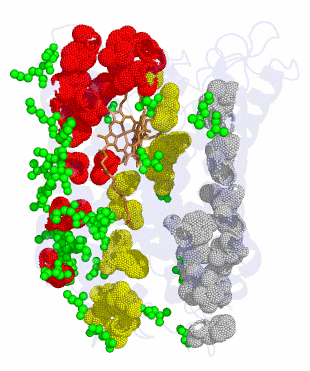
Supplementary data for Wang ZO and Pollock DD, " Coevolutionary patterns in cytochrome c oxidase
subunit I depend on structure and functional context" J Molecular Evolution, 2007
|